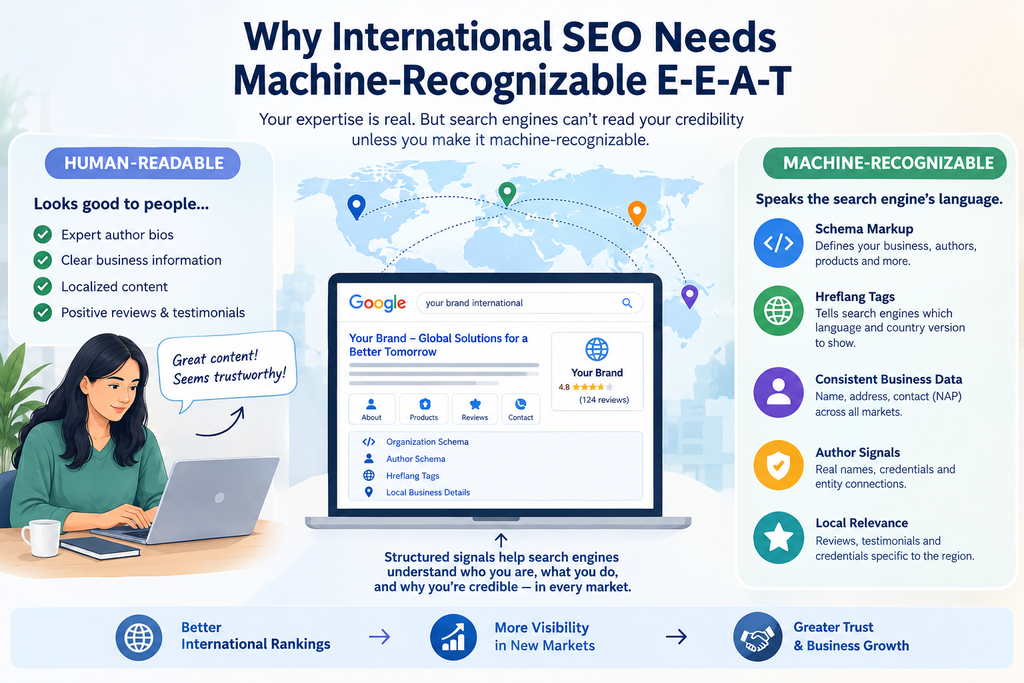
If you’re expanding into new markets and your rankings just won’t move, the problem usually isn’t your content quality. It’s that search engines can’t read your credibility. That’s the core issue with international SEO E-E-A-T: your brand can be genuinely experienced and trustworthy, but if that trust isn’t encoded in a way machines can parse, it might as well not exist to Google.
I’ve seen this play out directly. On one project, a client’s website had unclear author information and no structured data at all. Search engines had no reliable way to connect the content to a real, credible entity — so despite solid experience behind the brand, visibility in a new country’s search results stayed flat. The fix wasn’t more content. It was making the expertise legible to machines.
What “Machine-Recognizable” E-E-A-T Actually Means
E-E-A-T — Experience, Expertise, Authoritativeness, Trustworthiness — is a human concept. But Google doesn’t read your site the way a person does. It relies on structured signals: schema markup, hreflang tags, consistent business data, and clear authorship. If those signals are missing or inconsistent across markets, your international SEO E-E-A-T might exist on the page but be invisible in the systems that determine rankings.
This matters even more for international SEO trust signals, because you’re often introducing a brand to an entity graph that has zero prior history with it in that country or language. Without machine-readable signals in place, international SEO E-E-A-T stays theoretical instead of becoming something search engines can actually act on.
The Real Fix: What Made the Difference
On the project I mentioned, three changes moved the needle most:
- Author bios — real names, credentials, and a visible connection to the brand
- Organization schema — structured data clarifying who the business is, what it does, and where
- Clear business details — consistent name, address, and contact info across the site
Alongside that, hreflang tags helped search engines target the correct country and language version of each page, and broader schema markup for authority improved how clearly the site’s information came through in search results. None of these were content changes — they were structural ones. That distinction is the whole point.
On the project I mentioned, three changes moved the needle most:
- Author bios — real names, credentials, and a visible connection to the brand
- Organization schema — structured data clarifying who the business is, what it does, and where
- Clear business details — consistent name, address, and contact info across the site
Alongside that, hreflang tags helped search engines target the correct country and language version of each page, and broader schema markup for authority improved how clearly the site’s information came through in search results. None of these were content changes — they were structural ones. That distinction is the whole point.
A Common Mistake: Copy-Pasting Content Across Markets
One mistake I see constantly: brands expand into a new country and simply translate — or worse, duplicate — the same content without adapting author information, local business details, or cultural context. I worked with a brand that did exactly this. The content was accurate and well-written, but because it carried no local expertise signals, search engines had no reason to treat it as credible in that specific market. It read like a copy, because structurally, it was one — and that’s a fast way to weaken international SEO E-E-A-T before it even gets a chance to build.
This is a classic multilingual SEO trust signals failure. Language is only one layer. Local relevance — who’s writing it, what business entity backs it, what local reviews or credentials support it — is the layer that actually builds international SEO E-E-A-T machines can recognize, not just readers.
This is a classic multilingual SEO trust signals failure. Language is only one layer. Local relevance — who’s writing it, what business entity backs it, what local reviews or credentials support it — is the layer that actually builds machine-readable trust.
A Simple Audit Process for New Markets
When auditing a site’s E-E-A-T for a new country or language, I follow roughly the same sequence each time:
- Check author bios — are they present, localized, and credible for this market?
- Verify business details — name, address, contact info consistent with local expectations
- Confirm structured data — is organization schema present and accurate?
- Review local relevance — reviews, testimonials, or credentials specific to the region
- Validate hreflang tags — correct targeting for country and language
- Check content accuracy — not just translated, but locally accurate
- Monitor search visibility and AI-generated brand mentions — to catch signals that are missing or unclear after the fact
That last step matters more each year. As AI-driven search answers become a bigger share of visibility, cross-border content trust signals need to be readable not just by traditional crawlers, but by systems generating summarized answers.
Comparison: Human-Readable vs. Machine-Recognizable E-E-A-T
| Signal | Human-Readable | Machine-Recognizable |
| Author credibility | “Written by an expert” in the bio | Author schema + consistent entity across pages |
| Business trust | Contact page exists | Organization schema + NAP consistency |
| Language targeting | Translated content | Hreflang tags correctly implemented |
| Local relevance | Feels locally written | Localized reviews, credentials, structured signals |
If You Only Do One Thing This Month
Prioritize clear organization schema and accurate business information across the site — including author details and local presence. This single move helps search engines understand your brand’s identity, expertise, and relevance in a new market faster than almost anything else, and it lays the foundation everything else (hreflang, local content, reviews) builds on.
FAQs
Does E-E-A-T apply differently in international SEO than domestic SEO?
The principles are the same, but international markets start with less established trust for your entity. Structured signals matter more because there’s less existing history for search engines to draw on.
Is translating content enough for international E-E-A-T?
No. Translation addresses language, not credibility. Author signals, local business details, and cultural relevance need to be adapted too, or the content reads as generic to search engines.
What’s the fastest way to improve machine-recognizable E-E-A-T?
Start with organization schema and consistent business details. It’s foundational and typically has the clearest, fastest impact on how search engines interpret your brand’s credibility.
Conclusion
International SEO E-E-A-T isn’t about writing more trustworthy content — most brands already have that. It’s about translating that trust into a format machines can actually recognize: schema, hreflang, consistent authorship, and localized signals. Getting international SEO E-E-A-T right starts with organization schema and business details, then builds out from there — and it means never assuming translated content carries the same credibility as content built for a market from the ground up.
As a digital marketing freelancer consultant in Kochi, I’ve watched brands spend days on a video, only to lose viewers in the first few seconds by opening with a sales pitch. The fix isn’t to hide your brand. It’s to earn attention with a strong hook first, then bring your brand in once people have a reason to stay.